CDK vs Reynolds vs Tekion vs Custom: Which Technology Stack Is Right for Your Dealership?
A neutral, technical comparison of the four primary software paths available to automotive retailers, analyzing architectural debt, capital costs, and operational velocity.
Executive Summary & Key Findings
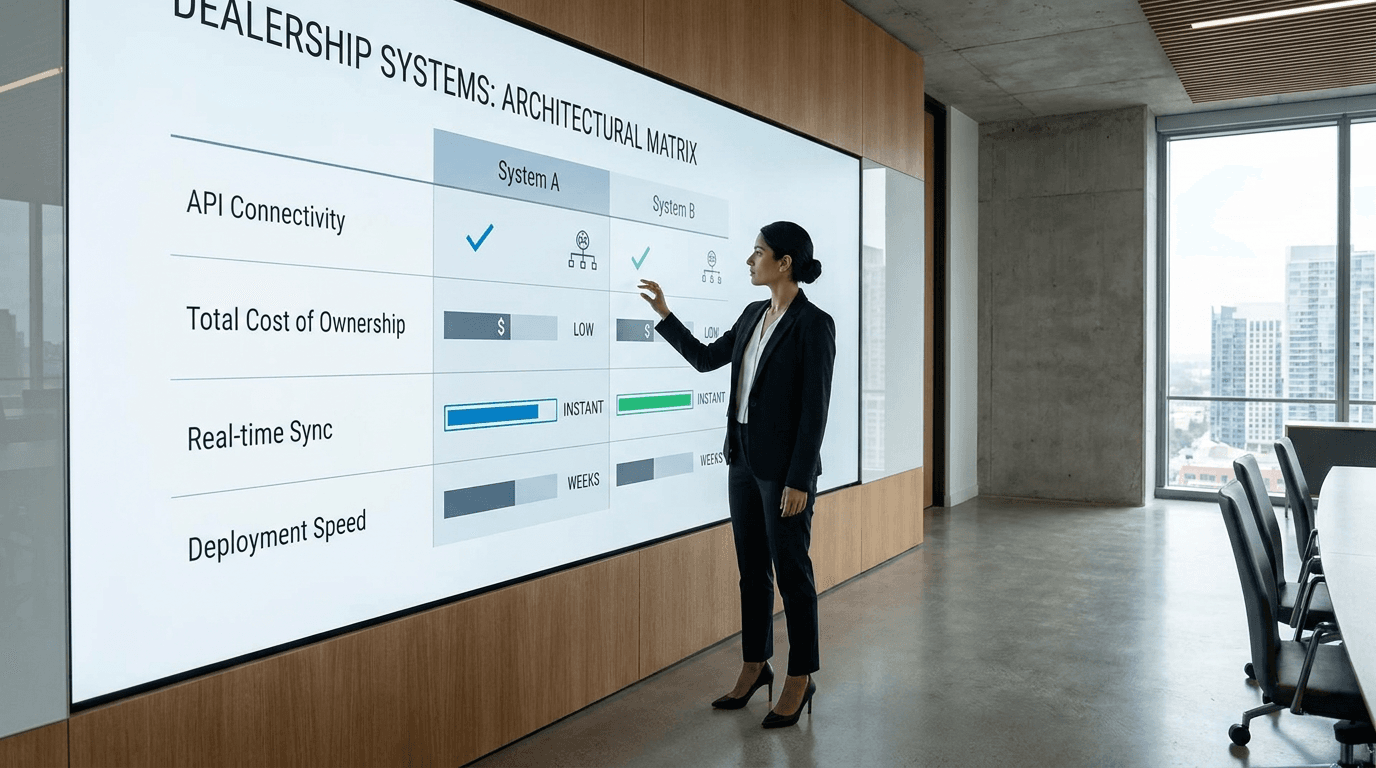
- Legacy mainframes provide deep OEM compliance but suffer from 40-year-old architectural debt, high integration taxes, and rigid multi-year contracts.
- First-generation cloud challengers offer improved user interfaces but frequently suffer from rapid price inflation and closed proprietary ecosystems.
- Custom in-house software development requires $3M to $10M in upfront capital and multi-year ongoing maintenance that rarely yields positive ROI.
- Open automotive operating systems combine cloud-native scalability, zero-cost REST/GraphQL APIs, and rapid deployment for modern dealer groups.
The Four Paths in Retail Automotive Technology
Every dealership executive evaluating their technology infrastructure in 2026 faces a critical strategic crossroads. The market today presents four distinct technology paths: legacy mainframe systems (CDK Global, Reynolds & Reynolds), first-generation cloud challengers (Tekion), in-house custom software development, and modern open automotive operating systems (DMSPilot).
Each of these approaches represents fundamentally different compromises between capital expense, operational agility, vendor dependence, and data ownership. Making the right decision requires looking past sales presentations and conducting an objective technical evaluation of each architecture.
Path 1: Legacy Mainframes (CDK Drive & Reynolds ERA-IGNITE)
Legacy platforms remain the incumbent choice for many multi-rooftop groups primarily because of their decades of operational history and comprehensive factory communications certifications across every global vehicle manufacturer.
However, these systems are burdened by extreme architectural debt. Built on Pick OS and database architectures designed in the late 1970s and 1980s, they rely on terminal emulation screens, nightly batch FTP data processing, and closed proprietary databases.
To connect external software, legacy vendors force dealers into restrictive certified integration programs that charge exorbitant access fees, effectively penalizing dealerships for adopting modern technology tools.
Path 2: First-Generation Cloud Challengers (Tekion)
Tekion emerged as the first well-funded modern cloud challenger to legacy DMS vendors, introducing web-native user interfaces, mobile service write-up capabilities, and modern consumer-facing features.
While Tekion proved that modern cloud technology could handle dealership operations, many dealer groups have encountered growing pains as the vendor scaled. Dealers report rising subscription tiers upon contract renewal, proprietary bundling that forces adoption of vendor-owned point solutions, and occasional software instability during rapid feature rollouts.
Furthermore, while more modern than mainframes, first-generation cloud providers still operate largely as closed gardens, restricting direct SQL access and limiting third-party integration freedom.
Path 3: In-House Custom Software Development
Faced with frustration over commercial vendors, several large dealer groups have explored developing custom software in-house, hiring internal engineering teams to build bespoke CRM, desking, or inventory solutions.
While appealing in theory, custom development in retail automotive is fraught with enormous financial risk. Building a complete DMS requires $3M to $10M in upfront engineering capital, hundreds of thousands in monthly cloud hosting, and continuous maintenance to keep pace with changing tax laws and lender interfaces.
Most fatally, navigating the complex web of OEM factory certifications, warranty processing APIs, and parts catalog feeds proves prohibitively difficult for internal IT teams, leading many groups to abandon custom projects after burning millions in capital.
Path 4: Modern Open Automotive Operating Systems (DMSPilot)
The modern open operating system paradigm represents the optimal balance of enterprise capability, open flexibility, and economic transparency. Built on modern microservices, containerized infrastructure, and real-time event streaming, open platforms provide the computational speed of tech giants at a fraction of enterprise cost.
Key characteristics include 100% data sovereignty, open REST and GraphQL APIs with zero third-party certification taxes, native mobile tablet workflows for sales and service, and transparent monthly subscription pricing with no 5-year lock-ins.
This open approach empowers dealership groups to build their ideal technology ecosystem, seamlessly connecting best-in-class software tools while maintaining an ultra-fast, unified operational core.
Comparative Decision Framework for Dealer Principals
For small single-point dealerships with established staff resistant to change, sticking with legacy systems may seem comfortable in the short term, though long-term costs continue to compound. For large progressive dealer groups seeking aggressive expansion and market dominance, modern open platforms offer the agility required to onboard new rooftops in weeks rather than months.
When making your evaluation, calculate the true 5-year Total Cost of Ownership including integration surcharges, demand live system speed demonstrations on real-world inventory data, and insist on speaking with current reference dealerships about operational reliability.
Related Automotive Intelligence
CDK vs Reynolds vs DMSPilot: What Dealership Groups Should Know Before Switching in 2026
Why Dealerships Lose $200K+ a Year to Disconnected DMS, CRM, and Inventory Systems