The Modern Dealership Technology Stack: How to Connect Your DMS, CRM, AI, Sales, Service & Parts
The authoritative blueprint for retiring the chaotic 14-vendor software stack and unifying your automotive retail operations on a single connected operating system.
Executive Summary & Key Findings
The average dealership licenses 14 disconnected software tools, creating massive vendor subscription overlap and chronic data fragmentation.
Unifying Variable and Fixed Operations on a shared event pipeline eliminates duplicate customer profiles and streamlines repair order workflows.
Real-time automated parts dispatching connects technician inspection findings directly to parts counter inventory in under 5 seconds.
Consolidating software vendors reduces direct licensing expenses by 40% while accelerating employee onboarding and operational speed.
The 14-Vendor Chaos: How Dealership Software Got Broken
Walk into almost any automotive dealership in North America today, and you will observe a dizzying patchwork of disconnected software systems. The sales desk uses one tool to desk deals, the BDC uses a separate CRM to track customer inquiries, the service lane uses a third-party app for digital multi-point inspections, the parts counter checks inventory on green-screen terminals, and the business office re-keys everything into a legacy accounting ledger.
This fractured architecture is the unintended consequence of twenty years of vendor point solutions attempting to patch the deficiencies of legacy mainframe DMS platforms. When legacy systems failed to innovate, dealers were forced to buy standalone third-party tools for every new capability.
The result is catastrophic operational complexity: 14 separate software contracts, dozens of brittle third-party integration bridges that break constantly, duplicate customer profiles scattered across databases, and hundreds of thousands of dollars spent annually on redundant vendor fees.
The average dealership pays 14 separate software vendors, resulting in over $12,000 per month in licensing overlap and dozens of brittle point-to-point integration bridges.
Pillar 1: The Single Unified Core Operating System
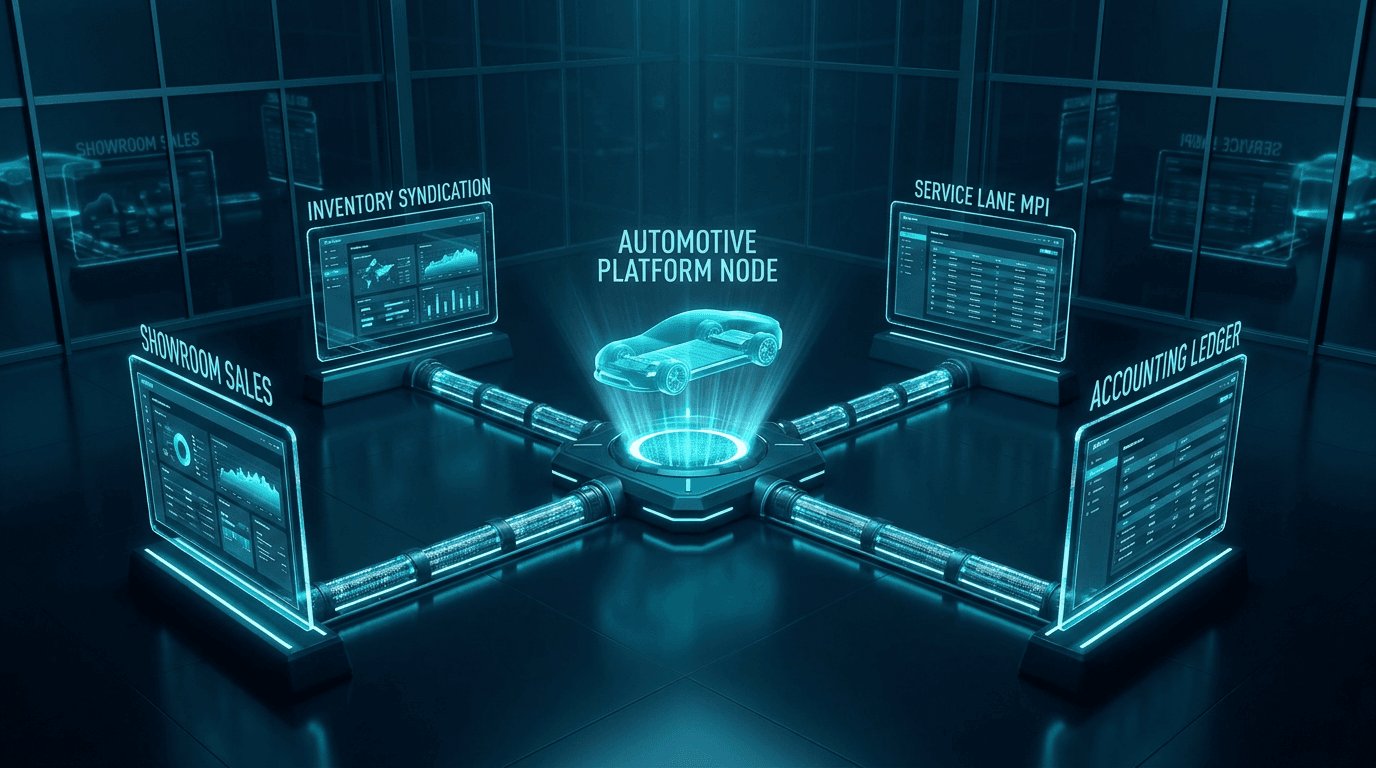
The foundation of the modern dealership technology stack is a unified core operating system that serves as the single source of truth across all rooftop departments. Rather than relying on periodic batch syncs or fragile third-party middleware, every business function accesses the same live transactional database.
When a customer updates their phone number on the dealership digital retailing website, that update is instantly reflected in the CRM, the service lane scheduling board, and the accounting ledger. There is never any ambiguity about which record is current.
This unified architecture eliminates the costly certified integration taxes imposed by legacy vendors and provides dealership executives with real-time, consolidated reporting across every department.
Pillar 2: Variable Operations and Digital Showroom Integration
In a connected stack, the boundary between the online storefront and the physical showroom completely disappears. A prospective vehicle buyer can begin configuring their deal online at 9:00 PM, submit their trade-in details, select lender financing terms, and upload credit documentation.
When the customer arrives at the dealership the following day, the sales manager pulls up the exact deal configuration on a tablet in one click. Every calculation, local sales tax rule, and lender buy rate matches the online quote to the penny.
The sales consultant spends their time providing an exceptional test drive experience rather than re-asking questions and re-keying customer information into a clunky desking terminal.
Pillar 3: Fixed Operations and Instant Parts Dispatching
The disconnect between the service drive and the parts department is a chronic source of dealership margin leak. In traditional setups, a service technician performs an inspection, writes down required parts on paper or a standalone app, and walks to the parts counter to check availability.
In a modern connected platform, the technician records a quick video multi-point inspection on their mobile tablet and tags the required service operations. The system instantly checks real-time parts inventory in the DMS ledger, automatically reserves the necessary parts from the bin, and dispatches an automated notification to parts pullers.
Simultaneously, an interactive estimate with video evidence is sent directly to the customer smartphone via text message. When the customer taps approve, the repair order updates immediately and the technician is cleared to begin work.
Mobile Video MPI: Technicians record 45-second video inspections directly on tablets
Real-Time Parts Reservation: DMS ledger reserves parts automatically as technician tags repairs
Customer SMS Approvals: Interactive digital estimate with video sent directly to customer smartphone
Instant Labor Punch: Technician begins approved operations immediately without leaving the service bay
Pillar 4: Autonomous AI and Real-Time Financial Accounting
A modern stack embeds autonomous AI directly into core workflows rather than bolting it on as an external chatbot. The AI monitors incoming customer communications, drafts personalized responses, detects customer purchasing signals, and alerts managers when a high-value customer enters the service drive.
In the accounting office, computer vision pipelines ingest vendor invoices, automatically match them against purchase orders and parts inventory receipts, and post general ledger journal entries without manual data entry.
Month-end closes, which traditionally require two to three weeks of frantic overtime, are completed in under three business days with full transactional audit trails and automated inter-company balance reconciliation.
The Consolidation Blueprint: Slashing Costs by 40%
Consolidating from 14 disparate software vendors down to a single connected automotive operating system generates immediate, massive financial and operational returns. Direct software licensing expenses drop by 35% to 50%, while IT overhead and server maintenance costs are eliminated entirely.
More importantly, dealership employees no longer waste hours navigating multiple logins, learning conflicting user interfaces, and dealing with broken data syncs. New hires can be trained and fully productive in days rather than months.
By unifying your entire dealership ecosystem onto an open, real-time operating platform, your dealership gains the computational velocity and operational efficiency necessary to dominate your market.
Retiring 14 point solutions in favor of a single unified automotive operating system cuts direct software expenses by 40% while accelerating employee onboarding.